
Small Estate Malaysia – Small Estate Distribution & Application
When a person passes away in Malaysia, family members often assume that every estate must go through the High Court. That is not necessarily the case. Depending on the value and nature of the deceased’s assets and other applicable conditions, the estate may qualify for small estate distribution in Malaysia through the Small Estate Distribution Division (Bahagian Pembahagian Pusaka) under the Department of Director General of Lands and Mines (JKPTG).
The law governing small estate Malaysia has undergone important changes. Under the current framework, a small estate is no longer limited to an estate containing land. According to JKPTG’s current guidance, a qualifying small estate may consist of movable property only, immovable property only, or a combination of both, provided that the total value does not exceed RM5 million at the date of the application. For a non-Muslim deceased, JKPTG also states as part of its current definition that the deceased did not leave a will.
This means that assets such as bank savings, shares and vehicles may potentially fall within the administration of small estates, even where the deceased did not own land, subject to the applicable legal requirements.
At The Law Chambers of Gurvin, we assist families in understanding estate and property administration procedures, including determining the appropriate legal route, reviewing estate documents, identifying land and movable assets, and advising on the steps required for a small estate application in Malaysia.
What Is a Small Estate in Malaysia?
A small estate (harta pusaka kecil) is an estate falling within the jurisdiction established under the Small Estates (Distribution) Act 1955 [Act 98].
Under JKPTG’s current definition, the deceased’s property may comprise:
- movable property only;
- immovable property only; or
- both movable and immovable property.
The total value of the deceased’s estate must not exceed RM5 million at the date the application is made. For a non-Muslim deceased, JKPTG’s current criteria also state that the deceased must not have left a will.
Immovable property commonly includes land and houses. Movable property may include savings, shares and vehicles.
This distinction is important because older information on the internet may still state that a deceased person must have owned land before an estate can qualify as a small estate. That is no longer an accurate description of the current framework.
Small Estates (Distribution) Act 1955
The principal legislation governing small estate distribution is the Small Estates (Distribution) Act 1955 [Act 98], also referred to in Malay as the Akta Harta Pusaka Kecil (Pembahagian) 1955.
JKPTG describes the Act as the main legislation used for the administration of small estates. It covers matters including the meaning of a small estate, jurisdiction, applications, hearings, distribution orders and appeals to the High Court.
JKPTG – Small Estates (Distribution) Act 1955
The Small Estates (Distribution) Regulations 1955 are also relevant to the procedural administration of small estates, including prescribed forms and fees.
The law should therefore be considered together with current JKPTG procedures rather than relying on older descriptions of the small-estate system.
Small Estates (Distribution) Act 1955 Amendment – What Changed?
This is particularly important for families reading older articles about the Small Estate Distribution Act Malaysia.
The Small Estates (Distribution) (Amendment) Act 2022 [Act A1643] substantially modernised and expanded the small-estate regime. The amended framework came into operation on 15 July 2024.
One of the most significant practical changes was the expansion of the small-estate jurisdiction. Under the current JKPTG position, the estate can consist entirely of movable property, entirely of immovable property, or both. The current monetary threshold is RM5 million.
Accordingly, older guidance stating that:
“A small estate must contain land”
or that:
“An estate containing only bank accounts or other movable assets cannot be a small estate”
should not be relied upon as a statement of the current law.
This is one reason it is important to check the latest Small Estate Distribution Act position and current JKPTG procedures before deciding whether to commence a High Court estate application.
What Is the Small Estate Threshold in Malaysia?
The current small estate threshold in Malaysia is RM5 million.
JKPTG states that the total value of the deceased’s property must not exceed RM5 million at the date the application is made.
This can include the combined value of qualifying movable and immovable assets.
For example, suppose a deceased person leaves:
- a residential property valued at RM1,200,000;
- bank savings of RM250,000;
- shares valued at RM150,000; and
- a motor vehicle valued at RM100,000.
The combined value would be approximately RM1.7 million. The fact that the estate contains both property and movable assets does not by itself disqualify it from the small-estate procedure.
Eligibility must still be considered against the other applicable requirements.
What Assets Can Be Included in a Small Estate?
A small estate in Malaysia can potentially involve both movable and immovable assets.
Examples of immovable property include land, houses and other interests in real property.
Examples of movable property may include bank savings, shares, vehicles and other assets supported by appropriate ownership documentation. JKPTG’s current document requirements specifically contemplate documents such as savings account statements, share certificates, takaful documents and vehicle ownership records.
This is a significant improvement to the earlier regime because an estate is no longer necessarily excluded from the small-estate procedure merely because it contains movable property or because there is no land.
Who Can Apply for Small Estate Distribution?
A small estate application Malaysia is not necessarily restricted to a spouse or child of the deceased.
JKPTG currently identifies several categories of persons or bodies who may apply, including:
- beneficiaries or heirs of the deceased, such as a spouse, children or parents;
- creditors or caveators;
- a purchaser under a valid Sale and Purchase Agreement;
- a chargee, assignee or lessee of the deceased’s land;
- Amanah Raya Berhad; and
- the relevant State Islamic Religious Council, subject to the applicable State enactment.
This can become particularly important where the deceased had entered into a property transaction before death or where another party has a recognised legal interest in the estate.
Small Estate Application Malaysia – Step-by-Step Procedure
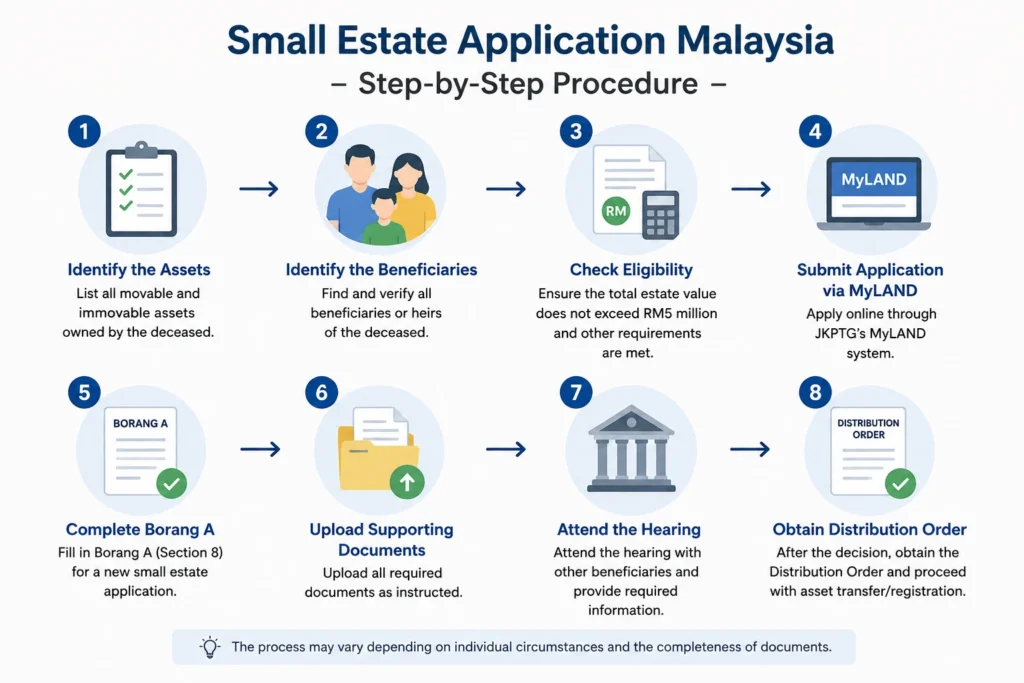
The precise small estate procedure depends on the circumstances, but the process generally begins by identifying the deceased’s assets, beneficiaries and liabilities and determining whether the estate falls within the small-estate jurisdiction.
Step 1 – Identify the deceased’s assets
The family should identify the assets owned by the deceased.
This may involve obtaining land titles or official land searches, bank statements, share information, vehicle ownership records and other evidence of ownership.
It is important to identify all known assets rather than focusing only on the family home.
Step 2 – Identify the beneficiaries or heirs
The applicant should establish the deceased’s family and beneficiary structure.
Documents such as identity cards, birth certificates and marriage certificates may therefore become important.
Step 3 – Determine whether the estate qualifies
Consider:
What assets did the deceased own?
What is their total value?
Did a non-Muslim deceased leave a will?
Does the estate fall within the RM5 million threshold?
These questions help determine whether the small estate distribution route is appropriate.
Step 4 – Submit the application through MyLAND
JKPTG currently requires applications for small estate distribution in Malaysia to be made online. Applicants may access the application through JKPTG Online or directly through the MyLAND system.
Step 5 – Complete Borang A
A first application is made using Borang A under section 8 of the Small Estates (Distribution) Act 1955.
JKPTG describes Borang A as the form used where an application for distribution of that deceased’s estate has not previously been made.
Step 6 – Upload the supporting documents
The appropriate supporting documents must be submitted with the application.
Step 7 – Attend the hearing
After the application has been processed, a hearing will be fixed.
The purpose of the hearing is to establish matters including the deceased’s assets, the persons entitled to inherit and the appropriate method of distribution.
Step 8 – Distribution order or authority
Following determination of the matter, the appropriate Distribution Order or Letter of Administration may be issued.
JKPTG states that after a Distribution Order or relevant Letter of Administration is obtained, the order should be presented to the appropriate Land Office for registration concerning immovable property, while the relevant agencies or institutions should be approached for movable property.
Borang A Small Estate Application
The keyword Borang A small estate commonly refers to the prescribed form used for a new small-estate application.
A new application under section 8 is made through Borang A.
JKPTG’s current SOP states that a new application is made online through MyLAND using Borang A. The completed petition is to be signed before a Magistrate or Commissioner for Oaths, together with the required supporting documents.
This should be distinguished from Borang P under section 17, which is used for a subsequent application in situations such as property omitted from an earlier completed application, cancellation of an administrator or trustee, or an application for authority to sell.
Therefore:
Borang A = new small estate application
Borang P = subsequent application after an earlier estate proceeding
Using the correct procedure is important, particularly where a family discovers additional assets after the first distribution has already been completed.
Documents Required for a Small Estate Application
The exact documents depend on the estate, but JKPTG’s current guidance identifies documents that may include:
- death certificate;
- identity cards of the applicant and beneficiaries;
- identity card or birth certificate for beneficiaries below 18;
- marriage certificate or marriage registration;
- land title or grant, where applicable;
- Sale and Purchase Agreement or Registry of Holding where appropriate;
- official land search;
- assessment bill or receipt where applicable;
- current documents showing ownership of movable property, including savings, shares, takaful and vehicles; and
- documents concerning debts owed by or to the deceased, where relevant.
Incomplete or inconsistent information can delay the administration process. Families should therefore identify the deceased’s assets and beneficiaries carefully before submitting the application.
What Happens at a Small Estate Hearing?
A hearing is not merely an administrative appointment.
According to JKPTG, its purpose includes verifying the deceased’s assets, investigating which beneficiaries are entitled to the estate and determining the method of distribution.
The applicant is required to attend together with another entitled beneficiary. Other beneficiaries who cannot attend may be required to provide the prescribed Borang DDA consent.
Original supporting documents should also be available where required.
Where family members disagree about the identity of beneficiaries, ownership of property or the proposed distribution, the matter may become more complicated and legal advice can be particularly useful.
How Is a Small Estate Distributed?
The law governing the procedure should be distinguished from the law determining who is entitled to inherit.
For a Muslim estate, distribution is generally determined according to Hukum Syarak/Faraid.
For a non-Muslim intestate estate, the Distribution Act 1958 [Act 300] determines the statutory entitlements.
JKPTG expressly confirms this distinction. It also states that distribution by agreement or muafakat may be possible where all entitled beneficiaries agree to the proposed distribution.
Accordingly, the principal laws that may become relevant include:
Small Estates (Distribution) Act 1955 [Act 98] – jurisdiction and administration of small estates.
Small Estates (Distribution) Regulations 1955 – procedural requirements, forms and fees.
Small Estates (Distribution) (Amendment) Act 2022 [Act A1643] – important amendments to the modern small-estate framework.
Distribution Act 1958 [Act 300] – intestate distribution for non-Muslims.
National Land Code 1965 [Act 56 of 1965] – relevant to land title and registration matters after the appropriate estate order has been obtained. JKPTG includes both the National Land Code and Small Estates Act among its land legislation.
For Muslim estates, applicable Islamic succession principles and State Islamic law may also need to be considered.
Small Estate Fees in Malaysia
There are official fees associated with the small-estate process.
According to JKPTG’s current FAQ, the order fee under regulation 18 of the Small Estates Regulations 1955 is presently:
0.2% of the total estate value where the estate is below RM2 million; and
0.3% where the total value is RM2,000,001 up to RM5 million.
For example, JKPTG gives the example of an estate valued at RM100,000 attracting an order fee of RM200.
These government fees should be distinguished from any legal fees, valuation costs, land searches, Commissioner for Oaths charges or other expenses that may arise depending on the particular case.
Real-World Example of a Small Estate Application
Consider a practical example.
A father passes away without leaving a will. He leaves a house in Selangor valued at RM850,000, RM120,000 in bank savings, shares valued at RM70,000 and a vehicle valued at RM60,000.
The total estate is approximately RM1.1 million.
Under outdated information, the family might assume that the Land Office route can deal only with the house while the bank accounts and shares require a separate High Court proceeding.
That assumption should not now be made.
Under JKPTG’s current criteria, a qualifying small estate can comprise immovable and movable property together, provided the total estate does not exceed RM5 million and the other requirements are met.
The family could therefore first investigate a small estate application rather than automatically commencing separate proceedings.
The applicant would identify the beneficiaries, collect the death certificate and family documents, obtain the property documents and official search, obtain current evidence of the bank account, shares and vehicle, and prepare the Borang A application through MyLAND.
At the hearing, the authority would determine the assets, entitled beneficiaries and appropriate distribution.
This example is illustrative only; the appropriate procedure always depends on the facts of the particular estate.
Our Experience with Estate and Land Matters
At The Law Chambers of Gurvin, estate administration frequently involves more than identifying the beneficiaries. Property documentation, land title records, ownership interests, bank assets and family relationships must often be considered together before the appropriate administration route can be determined.
In practice, one of the first issues we consider is which legal procedure actually applies. Commencing the wrong process can result in additional documents, unnecessary costs and delay.
Our experience in property and estate matters also assists where the estate includes land. Obtaining the estate order is only part of the process. The family may subsequently need to deal with registration of the order against the land title and implementation of the distribution.
JKPTG itself confirms that once the relevant Distribution Order or Letter of Administration has been obtained, it must be presented to the appropriate Land Office for immovable property and to the relevant institution for movable property.
We therefore approach a small estate claim in Malaysia as an estate-administration matter rather than treating Borang A as an isolated form-filling exercise.
Do You Need a Small Estate Lawyer?
lawyer is not mandatory for every straightforward small estate application Malaysia.
However, legal assistance may be useful where:
- it is unclear whether the estate qualifies;
- the deceased owned several properties or different classes of assets;
- beneficiaries cannot agree;
- the deceased’s ownership records are incomplete;
- property was purchased but title was not transferred;
- there are creditors or caveats;
- assets were omitted from an earlier distribution;
- an administrator needs to be changed;
- authority to sell estate property may be required; or
- there is uncertainty whether the Small Estate, Probate or another administration procedure applies.
A small estate lawyer can assist in reviewing the circumstances, identifying the appropriate procedure and helping the family prepare for the application and subsequent property administration.
Small Estate vs Probate vs Letters of Administration
hese terms should not be treated as interchangeable.
A small estate application is an administrative route under the Small Estates (Distribution) Act 1955 where the estate satisfies the applicable criteria.
A Grant of Probate generally concerns the High Court process where a deceased left a valid will appointing an executor.
Letters of Administration generally concern court-based administration where an administrator must be appointed, although the small-estate regime itself can also involve the issuance of administrative authority depending on the circumstances.
For SEO and, more importantly, legal clarity, this page focuses specifically on small estate distribution in Malaysia.
If the deceased left a will, see our separate guide to Grant of Probate in Malaysia.
Where the appropriate route is a High Court intestate administration, see our separate guide to Letters of Administration in Malaysia.
Why Should Small Estate Administration Not Be Delayed?
Delaying estate administration can make matters considerably more difficult.
JKPTG specifically identifies several reasons for dealing with an estate promptly, including preventing the number of beneficiaries from increasing through successive deaths, facilitating distribution, allowing beneficiaries to make use of inherited assets, avoiding assets becoming frozen or abandoned, and reducing the risk of unclaimed savings being transferred to the Registrar of Unclaimed Moneys.
This is particularly relevant to inherited land.
Where several generations pass away before an estate is properly administered, determining each successive beneficial entitlement can become substantially more complicated.
Frequently Asked Questions About Small Estate Malaysia
What is considered a small estate in Malaysia?
Under JKPTG’s current criteria, a small estate may consist of movable property, immovable property or both, with a total value not exceeding RM5 million at the date of application. For a non-Muslim deceased, JKPTG’s current definition also states that the deceased did not leave a will.
What is the current small estate threshold in Malaysia?
The current threshold is RM5 million in total estate value at the date the application is made.
Must a small estate include land?
No. Under the current framework, a qualifying small estate can consist of movable assets only, immovable assets only, or both.
Can bank accounts be included in a small estate application?
Potentially, yes. JKPTG recognises movable assets such as savings and shares within the current small-estate framework, subject to the applicable eligibility requirements.
What is Borang A for a small estate?
Borang A is used for a new application under section 8 of the Small Estates (Distribution) Act 1955 where an application for distribution of the deceased’s estate has not previously been made.
What is Borang P?
Borang P is used for a subsequent application under section 17, including circumstances where assets were omitted from an earlier completed application or certain further administrative orders are required.
How do I apply for a small estate in Malaysia?
Applications are currently made online through JKPTG’s MyLAND system. Supporting documents must be uploaded and the matter will proceed through the applicable small-estate process.
Who can make a small estate application?
Potential applicants include beneficiaries, creditors or caveators, certain purchasers, chargees, assignees or lessees, Amanah Raya Berhad and, where applicable, a State Islamic Religious Council.
How is a non-Muslim small estate distributed?
For a non-Muslim intestate estate, distribution is generally determined under the Distribution Act 1958 [Act 300], subject to the circumstances. JKPTG also recognises consensual distribution where all entitled beneficiaries agree.
How is a Muslim small estate distributed?
The distribution of a Muslim deceased’s estate is generally determined according to Hukum Syarak/Faraid, subject to the applicable Islamic law and estate circumstances.
What happens after the Small Estate Distribution Order is issued?
For immovable property, the relevant order should be submitted to the appropriate Land Office for registration. For movable assets, it should be submitted to the relevant bank, financial institution, agency or other body responsible for the asset.
Do I need a lawyer for a small estate application?
Not every small-estate application requires a lawyer. Legal assistance may nevertheless be useful where eligibility is uncertain, assets or beneficiaries are complicated, land issues exist, beneficiaries disagree, additional assets are discovered or the correct estate-administration procedure is unclear.
Small Estate Lawyer in Kuala Lumpur, Selangor & Negeri Sembilan
The Law Chambers of Gurvin is based in Kuala Lumpur and provides legal assistance for small estate applications, estate distribution and related land matters primarily in Kuala Lumpur, Selangor and Negeri Sembilan.
We assist clients with small estate matters involving properties and beneficiaries in areas including Kuala Lumpur, Setapak, Wangsa Maju, Cheras, Kepong, Petaling Jaya, Subang Jaya, Shah Alam, Klang, Puchong, Ampang, Gombak, Selayang, Kajang, Bangi, Seremban, Nilai, Port Dickson and surrounding areas.
Depending on the nature and location of the deceased’s assets, a small estate matter may involve dealings with the relevant Pejabat Pembahagian Pusaka (JKPTG) and, where land or property is involved, the relevant Land Office for subsequent registration and transfer matters. JKPTG confirms that its state functions include processing small-estate distribution applications.
Our firm can assist in reviewing the estate, identifying the appropriate procedure, preparing the necessary documentation, advising beneficiaries on the small estate application, and handling the legal and property-related steps required to complete the administration of the estate.