
Deed of Receipt and Reassignment in Malaysia
A Deed of Receipt and Reassignment (DRR) is commonly used when property financing has been fully settled and the bank’s security over the property was created by way of an assignment.
At The Law Chambers of Gurvin, our conveyancing lawyers assist property owners with Deed of Receipt and Reassignment matters in Kuala Lumpur, Selangor and other parts of Peninsular Malaysia. We assist with reviewing the existing property and financing documents, corresponding with the bank and other relevant parties, and completing the necessary documentation following settlement of the financing.

What is a Deed of Receipt and Reassignment?
A Deed of Receipt and Reassignment is a legal document generally used to acknowledge settlement of the financing and to reassign to the property owner the rights and interests that were previously assigned to the bank as security.
This commonly arises where the property did not have an individual or strata title registered in the purchaser’s name when the financing was obtained. Instead of taking a registered charge over the property title, the bank’s security may have been created through a Deed of Assignment and other security documentation.
After the financing has been fully settled, the bank’s security does not necessarily end simply because the final payment has been made. The appropriate release and reassignment documentation should also be completed.
When is a Deed of Receipt and Reassignment Required?
A Deed of Receipt and Reassignment may be required where:
- the property financing has been fully settled or redeemed;
- the bank’s security was created through an assignment;
- the relevant rights and interests in the property had previously been assigned to the bank as security; and
- the bank’s security now needs to be released following settlement.
Whether a DRR is required will depend on the property’s title status and the original financing and security documents.
Property owners who are unsure should have their Sale and Purchase Agreement, Deed of Assignment and financing documents reviewed before determining the appropriate procedure.
Deed of Assignment and Deed of Receipt and Reassignment
A Deed of Assignment and a Deed of Receipt and Reassignment are closely related, but they perform different functions.
A Deed of Assignment may be used to assign the purchaser’s rights and interests relating to the property to the bank as security for financing.
Once the financing has been fully settled, the Deed of Receipt and Reassignment may be used to acknowledge settlement and reassign the relevant rights and interests.
A simple way to understand the process is:
Property financing obtained
↓
Deed of Assignment
Rights and interests are assigned to the bank as security
↓
Financing fully settled or redeemed
↓
Deed of Receipt and Reassignment
The relevant rights and interests are reassigned following settlement
The exact documentation will depend on the original transaction and security arrangements.
Why is a Deed of Receipt and Reassignment Important?
Property owners sometimes assume that once their housing loan has been fully paid, nothing further needs to be done.
However, repayment of the financing and release of the bank’s security documentation are separate matters.
Completing the appropriate reassignment documentation helps ensure that the documents relating to the bank’s security properly reflect that the financing has been settled.
This can also become important when the owner later wishes to sell, transfer or otherwise deal with the property.
Deed of Receipt and Reassignment Procedure in Malaysia
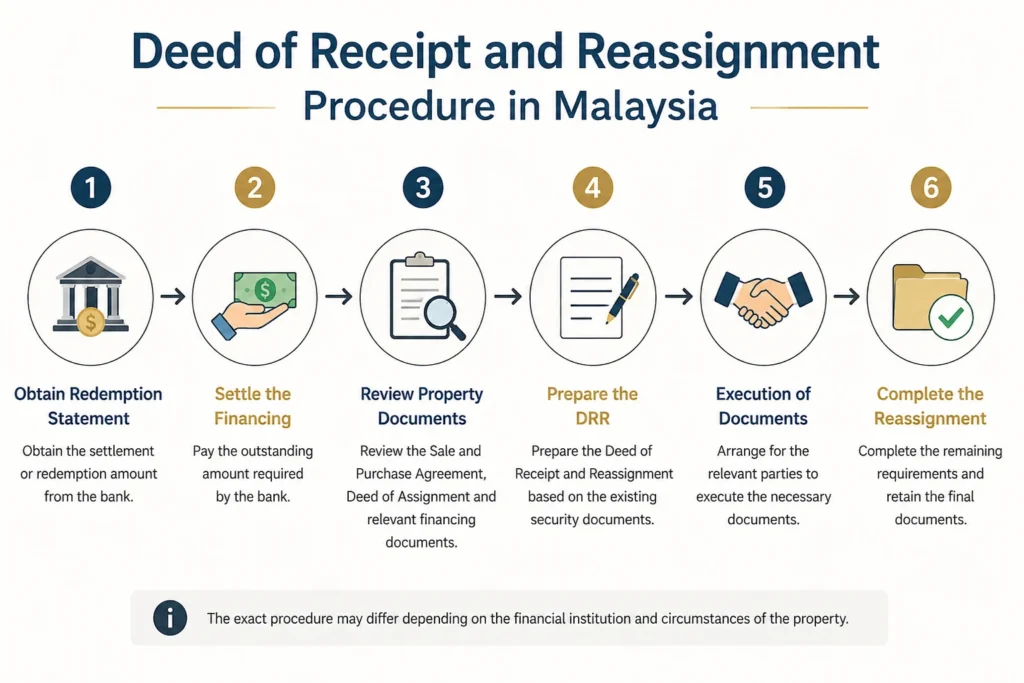
The Deed of Receipt and Reassignment procedure in Malaysia may differ depending on the bank, property and original security documents.
Generally, the process may involve the following:
1. Obtain the Redemption or Settlement Amount
Where financing remains outstanding, the amount required to fully settle the facility is obtained from the bank.
The bank may issue a redemption statement setting out the amount required for settlement as at the relevant date.
2. Settle the Outstanding Financing
The required redemption or settlement amount is paid to the bank in accordance with the applicable requirements.
3. Review the Existing Property and Security Documents
The relevant documents are reviewed to establish how the bank’s security was created and determine the appropriate documentation required to release it.
These may include the Sale and Purchase Agreement, Deed of Assignment and financing documents.
4. Prepare the Deed of Receipt and Reassignment
Where applicable, the necessary Deed of Receipt and Reassignment is prepared to record the settlement and reassignment of the relevant rights and interests.
5. Execution by the Relevant Parties
The necessary documents are executed by the relevant parties in accordance with the applicable requirements.
6. Complete the Reassignment
Any remaining documentation and procedural requirements are attended to. The completed documents should be retained safely as part of the property’s important records.
The exact procedure may vary between financial institutions and according to the original property and financing arrangements.
What is a Redemption Statement?
A redemption statement is generally a document or statement setting out the amount required to fully settle the outstanding financing as at a particular date.
Depending on the financing arrangement, the redemption amount may include the outstanding principal or financing amount, applicable interest or profit and other amounts payable under the facility.
The redemption statement is therefore connected with the settlement of the financing, but it is not the same as a Deed of Receipt and Reassignment.
Settlement of the redemption amount is one part of the process. The appropriate documentation to release or reassign the bank’s security may still need to be completed afterwards.
What is a Redemption Letter?
The expression redemption letter may be used in connection with correspondence or documentation concerning the settlement or redemption of property financing.
The terminology and documents used may differ between banks.
A redemption letter or redemption statement should not automatically be treated as the document that reassigns the bank’s rights and interests. The existing security documents and the documents issued by the financial institution should be reviewed to determine what further steps are required.
Documents Commonly Required for a Deed of Receipt and Reassignment
The documents required will depend on the property, bank and original financing arrangements. They may include:
- Sale and Purchase Agreement;
- existing Deed of Assignment;
- financing or facility documents;
- redemption statement or settlement documents;
- identification documents of the property owner;
- relevant correspondence or documents from the bank;
- developer documents, where applicable; and
- other supporting documents required for the particular transaction.
If some of the original documents are unavailable, further steps may be necessary depending on the circumstances.
Does the Developer Need to Be Involved?
In certain cases, the developer may need to be contacted as part of the documentation process.
This is particularly relevant where the individual or strata title had not been issued or perfected and the transaction was originally documented through assignment.
Depending on the circumstances, relevant information or documentation may therefore need to be obtained from the developer, bank or other parties involved in the original property transaction.
Developer involvement is not required in every case. The existing property documents should first be reviewed to determine what is necessary.
Deed of Receipt and Reassignment vs Discharge of Charge
A Deed of Receipt and Reassignment and a Discharge of Charge are not the same legal process, although both may arise after property financing has been settled.
A Discharge of Charge generally applies where the bank has a registered charge over an individual or strata title.
A Deed of Receipt and Reassignment generally applies where the bank’s security was created through an assignment rather than a registered charge over the property title.
In simple terms:
| Deed of Receipt and Reassignment | Discharge of Charge |
|---|---|
| Security generally created through assignment | Registered charge exists over the title |
| Commonly associated with assignment-based financing documentation LPPSA example | Individual/strata title and registered charge involved |
| Rights and interests are reassigned following settlement | Registered charge is discharged |
| DRR documentation may be required | Form 16N is generally used for discharge of the registered charge |
The correct procedure depends on the property’s title status and the security documentation.
Property owners dealing with a registered charge can read more about our Discharge of Charge in Malaysia services.
What Does Deed of Receipt and Reassignment Mean in Malay?
People searching for Deed of Receipt and Reassignment in Malay may be trying to understand the document in simpler terms or obtain its Malay terminology.
In general terms, a Deed of Receipt and Reassignment records the receipt or settlement of the amount owing and the reassignment of rights or interests that had previously been assigned as security.
The precise Malay terminology used for a legal document may depend on the document and transaction. A legal document should therefore not be translated or interpreted solely based on a literal translation of its title.
How Long Does a Deed of Receipt and Reassignment Take?
There is no fixed completion period applicable to every DRR matter.
The time required can depend on:
- the bank or financial institution involved;
- whether the financing has already been fully settled;
- availability of the original Deed of Assignment and property documents;
- the bank’s processing and execution time;
- whether developer involvement is required; and
- whether there are any issues with the existing documentation.
Where documents are missing or additional confirmation is required from the bank, developer or other parties, the process may take longer.
Legal Fees for a Deed of Receipt and Reassignment
Legal fees will depend on the work required and the circumstances of the particular property and financing.
There may also be applicable disbursements or administrative expenses depending on the documents and work required.
At The Law Chambers of Gurvin, we can review the available documents and provide a quotation based on the work necessary to complete the matter.
Legal Framework for Deed of Receipt and Reassignment in Malaysia
The Malaysian Bar Council Conveyancing Practice Committee explains that after the redemption sum has been fully paid, the method used to release a bank’s security depends on the property’s title status.
A Discharge of Charge generally applies to a property with an individual or strata title where a charge has been registered, while a Deed of Receipt and Reassignment applies to property without an individual or strata title where the bank’s security was created through an assignment.
The Deed of Receipt and Reassignment operates to reassign the relevant rights, title and interest held by the financier back to the assignor following settlement of the financing.
For housing accommodation governed by the Housing Development (Control and Licensing) Act 1966, Section 22D also contains provisions concerning assignments of rights and interests in housing accommodation and notice of assignment to the housing developer.
Our Experience with Property Reassignment Matters
At The Law Chambers of Gurvin, we have handled conveyancing and property financing matters involving properties in Kuala Lumpur, Selangor and Negeri Sembilan, including Seremban.
Our experience includes dealing with Malaysian banks and financial institutions in property financing and release matters, including Maybank, RHB Bank, Public Bank, Alliance Bank and Hong Leong Bank, Ocbc Bank among others.
Depending on the matter, our work may include:
- reviewing existing Deeds of Assignment and property documents;
- corresponding with banks regarding settlement and release documentation;
- reviewing redemption and settlement documents;
- preparing the necessary reassignment documentation;
- liaising with developers where required; and
- advising property owners on the appropriate release process based on their existing security documentation.
The examples above are general descriptions of the types of matters we have handled. Client confidentiality is maintained.
Author: Gurvinder Kaur, LL.B (Hons), Multimedia University
Testimonial
⭐⭐⭐⭐⭐ Google Review
“After completing my bank settlement, I needed assistance with the discharge of charge for my property. Ms Gurvinder handled the matter and she explained the documents required and the expected timeline clearly. Communication was smooth and I always received prompt responses. It was reassuring to have an experienced lawyer managing my property discharge. Overall, I had a positive experience with this law firm in Setapak Kuala Lumpur”
—Yeok Choo Ang
⭐⭐⭐⭐⭐ Google Review
“When I finally cleared my mortgage, the bank issued a redemption letter confirming full settlement. I did not understand the legal documents required for the discharge of property. The lawyer Ms Gurvinder Kaur explained and prepared the deed of receipt and reassignment documents, and assisted with the process to revoke POA linked to the loan. The whole matter was handled efficiently with regular updates. A reliable lawyer and legal firm in KL. Much recommended.r”
—Ho KH
Frequently Asked Questions
What is a Deed of Receipt and Reassignment?
A Deed of Receipt and Reassignment is generally a legal document used following settlement of financing to acknowledge repayment and reassign rights and interests that had previously been assigned to the bank as security.
When do I need a Deed of Receipt and Reassignment?
A DRR may be required after property financing has been fully settled where the bank’s security was created through an assignment. The original property and financing documents should be reviewed to determine the appropriate procedure.
Is a Deed of Receipt and Reassignment the same as a Deed of Assignment?
No. A Deed of Assignment may be used to assign rights and interests as security for financing, while a Deed of Receipt and Reassignment may be used following settlement to reassign the relevant rights and interests.
Is a DRR the same as a Discharge of Charge?
No. A Discharge of Charge generally concerns the removal of a registered charge over a property title. A DRR generally concerns the reassignment of rights and interests that had been assigned as security.
What is a redemption statement?
A redemption statement generally states the amount required to fully settle outstanding financing as at a specified date. It is not the same as the Deed of Receipt and Reassignment.
Does settling my property loan automatically complete the reassignment?
Not necessarily. Settlement of the financing and completion of the relevant release or reassignment documentation are separate matters.
Do I need the original Deed of Assignment?
The existing Deed of Assignment is an important document for determining how the security was created. The documents required will depend on the circumstances and should be reviewed before proceeding.
Does the developer need to sign the Deed of Receipt and Reassignment?
Developer involvement depends on the property and original documentation. It is not required in every case. The relevant documents should first be reviewed to determine whether the developer needs to be involved.
Do I need a lawyer for a Deed of Receipt and Reassignment?
A conveyancing lawyer can review the existing security documentation, correspond with the bank and other relevant parties and prepare or attend to the documentation required to complete the reassignment.
How much does a Deed of Receipt and Reassignment cost?
Legal fees and other expenses depend on the documents, bank requirements and work required for the particular matter. A quotation can be provided after the relevant information and documents have been reviewed.
Contact Our Conveyancing Lawyers
If you have fully settled your property financing or received a redemption or settlement document from your bank, our conveyancing lawyers can review your existing property and financing documents to determine whether a Deed of Receipt and Reassignment, Discharge of Charge or another process is required.
The Law Chambers of Gurvin assists property owners with conveyancing and property matters in Kuala Lumpur, Selangor and other parts of Peninsular Malaysia