
Landlord and Tenant Disputes Lawyer in Malaysia
A landlord and tenant dispute can arise at any stage of a tenancy. Common problems include unpaid rent, breach of the tenancy agreement, damage to the property, disputes over deposits, early termination and tenants who refuse to vacate after the tenancy has expired or been terminated.
At The Law Chambers of Gurvin, we assist landlords and tenants with residential and commercial tenancy disputes, particularly for properties in Kuala Lumpur and Selangor. Our work includes Letters of Demand, tenancy termination, rental arrears, recovery of vacant possession, court proceedings and enforcement of court orders.
In our experience, tenancy disputes are easier to manage when the correct remedy is identified from the beginning. A landlord who wants to recover unpaid rental may require a different legal remedy from a landlord whose main concern is recovering possession of the property.
It is therefore important to review the tenancy agreement, the nature of the breach and the available evidence before taking action.

Common Landlord and Tenant Disputes in Malaysia
Some of the landlord and tenant disputes we commonly encounter include:
- unpaid rent and accumulated rental arrears;
- tenant refusing to vacate after expiry or termination;
- breach of the tenancy agreement;
- unauthorised occupants or subletting;
- damage to the rented property;
- disputes over repairs and maintenance;
- early termination of the tenancy;
- misuse of residential or commercial premises;
- security and utility deposit disputes; and
- failure to deliver vacant possession.
The tenancy agreement is usually the starting point.
Payment records, WhatsApp conversations, emails, photographs, notices, inventories and other supporting documents should also be reviewed. If court proceedings become necessary, these documents may form important evidence.
Tenant Not Paying Rent – What Can the Landlord Do?
Rental arrears are one of the most common tenancy problems.
Where a tenant stops paying rent, the landlord should first check the tenancy agreement to determine the payment date, any grace period, default provisions and the contractual rights available following non-payment.
Depending on the circumstances, a formal Letter of Demand may be issued requiring the outstanding rent and other sums properly due to be paid within a specified period.
If the tenant continues to default, the landlord may consider further remedies, which may include a civil claim for the debt, distress proceedings or, where legally justified, termination and proceedings for recovery of possession.
Proper records are particularly important. A landlord should keep bank statements, rental schedules, correspondence and any messages in which the tenant acknowledges the outstanding amount.
Tenant Eviction Notice and Tenant Eviction Letter
A tenant eviction notice is commonly understood as a notice requiring a tenant to leave the premises. However, Malaysian law does not provide one universal eviction letter that is suitable for every tenancy.
The correct notice depends on the tenancy agreement and the circumstances.
For example, a demand for unpaid rent is different from a notice terminating the tenancy. A termination notice may also be different from a subsequent demand requiring vacant possession.
A generic tenant eviction letter obtained online may therefore cause problems if it does not reflect the actual termination provisions or notice period in the signed tenancy agreement.
Before a notice is issued, it is advisable to determine:
- whether a breach has occurred;
- whether the breach gives a right to terminate;
- whether notice must first be given;
- how much notice is required; and
- whether the tenant has been given an opportunity to remedy the breach.
The wording and timing of the notice can become important if possession proceedings are later commenced.
Recovering Possession from a Tenant in Malaysia
A landlord who owns the property should not assume that ownership alone allows the landlord to physically remove an occupant.
Section 7(2) of the Specific Relief Act 1950 (Act 137) is particularly relevant. Where immovable property has been let under a tenancy, the tenancy has ended and the occupier continues to remain in occupation, recovery against that occupier must be pursued through court proceedings.
This is why landlords should be cautious about changing locks, entering the property by force or physically removing a tenant and the tenant’s belongings.
Even where the tenancy has clearly expired, recovery of possession should be carried out through the proper legal process.
Legal Process to Recover a Tenanted Property
Although every case depends on its particular facts, the process will commonly involve several stages.
1. Review the Tenancy Agreement
The tenancy agreement should first be examined to determine whether the tenancy has expired or whether there are contractual grounds for termination.
2. Issue the Appropriate Notice
Depending on the circumstances, the landlord may need to issue a Letter of Demand, notice of breach, termination notice and/or demand for vacant possession.
3. Give the Tenant the Required Time to Comply
If the tenant remedies the breach or voluntarily returns vacant possession, court proceedings may not be necessary.
4. Commence Court Proceedings
Where the tenant refuses to leave, the landlord may need to commence civil proceedings seeking vacant possession together with any other appropriate relief.
The Malaysian Judiciary identifies disputes between landlords and tenants as civil claims. Where there is a substantial dispute of fact, proceedings may generally be commenced by way of a writ of summons with the appropriate pleadings.
5. Obtain an Order for Possession
If the landlord succeeds, the Court may order the tenant or occupier to deliver vacant possession.
6. Enforce the Order if Necessary
If the occupant still refuses to leave despite the Court order, enforcement proceedings may then be required.
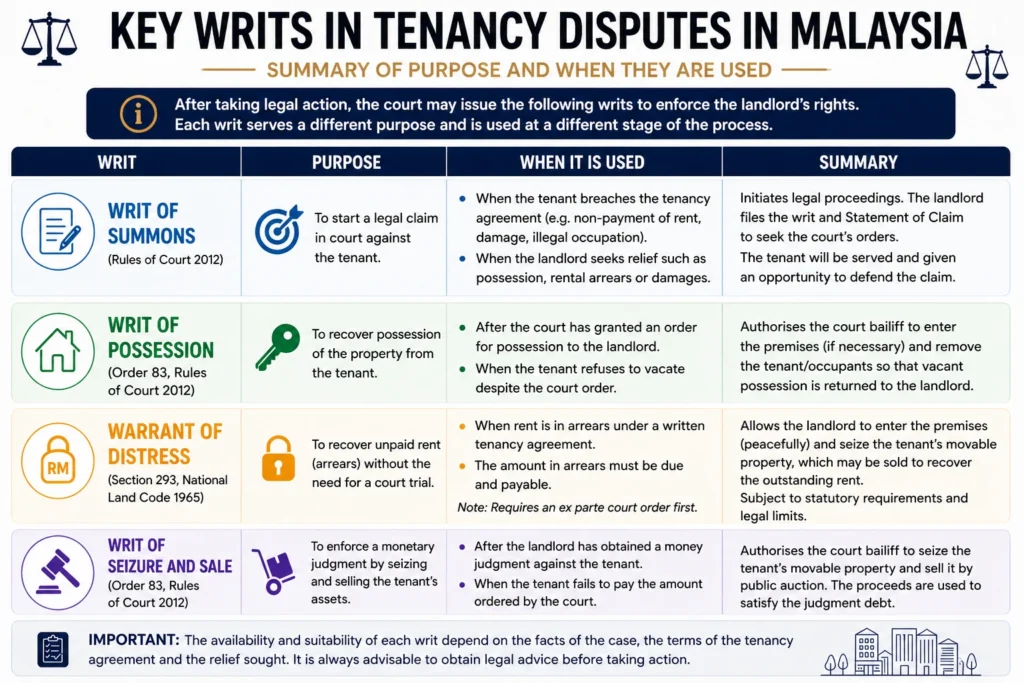
Writ of Possession in Malaysia
A writ of possession is an important enforcement mechanism where a Court has already ordered possession of immovable property but the occupant has failed to comply.
It should not be confused with the documents used to commence the original claim.
In simple terms, the process may look like this:
Tenancy expires or is terminated → tenant refuses to vacate → court proceedings → order for possession → tenant fails to comply → writ of possession.
The Rules of Court 2012 regulate the enforcement of judgments and orders, including enforcement relating to possession of immovable property.
This distinction is important. A landlord does not ordinarily apply for a writ of possession simply because the tenant is in breach. The appropriate possession order or judgment must first be obtained before the enforcement stage arises.
Our Experience with Writ of Possession
Our firm has handled tenancy disputes that proceeded beyond the initial demand and court proceedings to the actual enforcement and recovery of possession stage.
In one matter handled by our firm, the tenancy had been terminated and judgment for possession was obtained, but the occupant did not voluntarily return the premises.
The matter therefore proceeded to execution involving a writ of possession and the Court’s enforcement process.
This involved complying with the procedural requirements for execution and coordinating the necessary arrangements for possession of the property to be recovered lawfully.
This practical experience is important because obtaining a judgment is not always the end of a landlord tenant dispute. The landlord’s actual objective may be to recover the physical property, which can require a further enforcement stage.
Client names and identifying property details are omitted to preserve confidentiality.
Writ of Distress and Unpaid Rental
Where the principal issue is rental arrears, distress proceedings may be another remedy available to a landlord.
The Distress Act 1951 (Act 255) provides a statutory procedure allowing a landlord, in appropriate circumstances, to seek recovery of rent through distress.
Section 5 of the Distress Act deals with applications for a warrant of distress for rent due and payable within the statutory period.
The phrase writ of distress is also commonly searched when landlords are looking for this remedy, but it is important to understand that distress is a specific statutory procedure and should not be confused with an eviction action.
A distress proceeding is principally concerned with recovery of rental arrears.
A writ of possession, on the other hand, concerns enforcement of an order for possession.
The remedy that should be pursued depends on what the landlord is seeking to achieve.
Tenant Holding Over and Double Rent
Another common dispute arises when a tenancy has expired or been terminated but the former tenant continues occupying the property.
This is commonly described as holding over.
Section 28(4)(a) of the Civil Law Act 1956 (Act 67) provides that a tenant holding over after determination of the tenancy may, at the landlord’s option, be chargeable with double rent until possession is given up or double value during the period of detention.
The Federal Court considered this provision in Rohasassets Sdn Bhd v Weatherford (M) Sdn Bhd & Anor [2019] 6 MLRA 594.
The Court clarified that the landlord does not have to prove wilful or contumacious conduct by the former tenant merely to establish a claim under section 28(4)(a). However, the landlord’s option to charge double rent must have been properly and lawfully exercised.
The circumstances surrounding continued occupation are therefore important. For example, whether the landlord consented to the continued occupation and how the landlord dealt with rental payments after expiry may require consideration.
A claim for double rent should therefore be assessed according to the particular facts rather than automatically included whenever a tenant stays beyond the original tenancy period.
Writ of Summons in a Tenancy Dispute
Where a tenancy dispute cannot be resolved through demands, notices or negotiation, civil proceedings may become necessary.
A writ of summons is a mode of commencing civil proceedings where there are substantial disputes of fact.
Depending on the circumstances, a landlord’s claim may include:
- outstanding rental;
- damages for breach of the tenancy agreement;
- vacant possession;
- damage to the property;
- double rent where legally applicable;
- interest; and
- costs, subject to the Court’s discretion.
A writ of summons and a writ of possession serve completely different functions.
The writ of summons may commence the legal action, whereas a writ of possession is an enforcement process after the appropriate possession order has been obtained.
Writ of Seizure and Sale
Where the landlord obtains a monetary judgment and the judgment debtor fails to make payment, further enforcement may be considered.
One enforcement method recognised under the Rules of Court 2012 is a writ of seizure and sale.
It may allow property liable to execution to be seized and, where necessary, sold towards satisfaction of the judgment debt.
The three remedies can therefore be broadly distinguished:
Writ of possession – enforcement for recovery of possession of premises.
Distress proceedings – statutory process concerning recovery of rental arrears.
Writ of seizure and sale – enforcement of an appropriate monetary judgment.
The availability and suitability of each remedy depend on the circumstances.
Legal Remedies Against Tenants in Malaysia
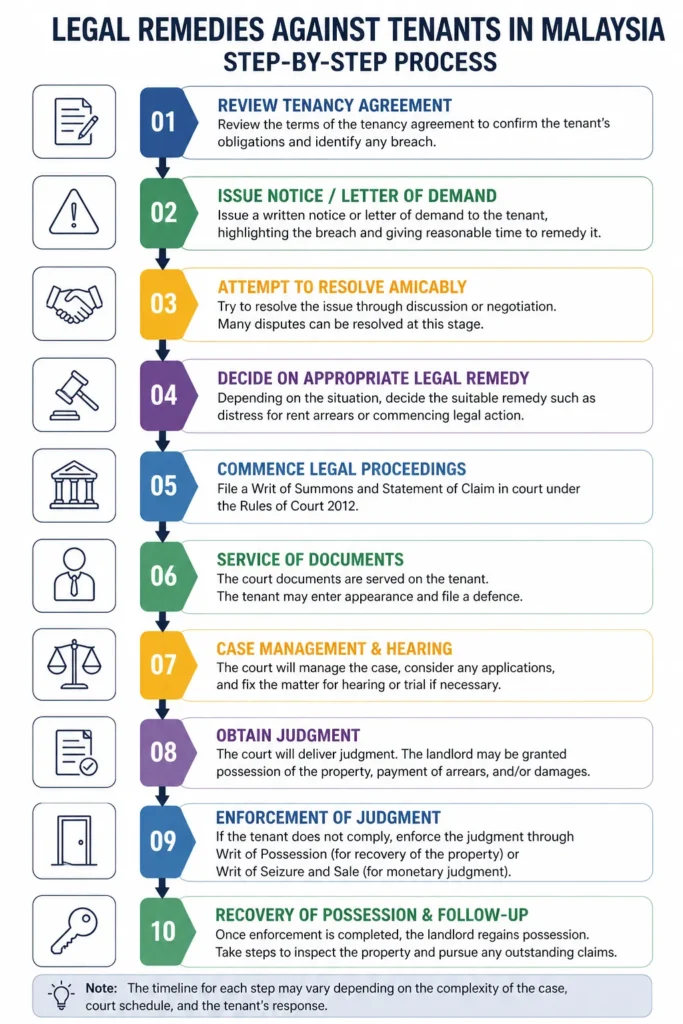
The appropriate legal remedies against tenants in Malaysia depend on what has actually happened.
A landlord may potentially consider:
Letter of Demand
A formal demand for outstanding rent or compliance with the tenancy agreement.
Termination of Tenancy
Where the tenancy agreement and circumstances provide a valid basis for termination.
Recovery of Rental Arrears
Court proceedings may be commenced to recover outstanding sums where payment is not made.
Distress Proceedings
The Distress Act 1951 provides a specific statutory remedy concerning rent in appropriate circumstances.
Recovery of Possession
Where a tenancy has ended and the former tenant refuses to leave, possession should be recovered through the proper court process.
Double Rent for Holding Over
Section 28(4)(a) of the Civil Law Act 1956 may be relevant where a former tenant continues to hold over without the landlord’s consent.
Enforcement of Judgment
Where a judgment or order is not complied with, further enforcement such as a writ of possession or, for an appropriate monetary judgment, a writ of seizure and sale may be considered.
The correct strategy depends on the tenancy agreement, the breach, the evidence and the result the landlord ultimately wants to achieve.
Evidence to Keep in a Landlord Tenant Dispute
Good documentation can make a significant difference if a dispute proceeds to Court.
Relevant documents commonly include:
- the signed tenancy agreement;
- proof of ownership where relevant;
- rental payment records;
- bank statements;
- deposit records;
- WhatsApp conversations and emails;
- Letters of Demand and termination notices;
- evidence that notices were delivered;
- photographs and videos of the premises;
- inventory lists;
- utility statements; and
- invoices or quotations for property damage.
Where damage to the property is claimed, photographs taken before and after the tenancy together with repair invoices or quotations can be particularly useful.
Our Experience in Landlord and Tenant Disputes
At The Law Chambers of Gurvin, we have handled residential and commercial tenancy disputes involving properties in Kuala Lumpur and Selangor.
In our experience, many cases begin with what appears to be a relatively straightforward issue such as a missed rental payment. The problem becomes more serious when arrears accumulate, notices are ignored or the tenant refuses to return the property.
We have assisted clients with Letters of Demand, rental arrears, tenancy termination, court proceedings, vacant possession and enforcement after a possession order has been obtained.
Because our firm also handles the drafting and review of tenancy agreements, we see both stages of a tenancy relationship — the clauses agreed when the tenancy begins and how those clauses operate when the relationship subsequently breaks down.
This allows us to focus on the remedy that is actually required, whether that means recovering money, terminating the tenancy, obtaining vacant possession or enforcing an existing Court order.
Testimonial
⭐⭐⭐⭐⭐ Google Review
“I was searching for civil case lawyers near me and contacted this legal firm regarding a dispute matter. The lawyer explained the litigation process clearly and answered my questions patiently. Communication was good throughout, and I appreciated the transparent fees from the start. As a litigation lawyer, she provided practical advice without making things complicated. Overall, I had a positive experience with this law firm in Kuala Lumpur (KL), Malaysia.”
—chew kokyit
Frequently Asked Questions – Landlord and Tenant Disputes Malaysia
Can I evict my tenant in Malaysia?
A landlord may be entitled to recover possession where the tenancy has expired or has been validly terminated. However, if the tenant refuses to leave, the landlord should recover possession through the proper court process rather than physically removing the tenant. Section 7(2) of the Specific Relief Act 1950 is particularly relevant to recovery of possession from a tenant who remains in occupation after the tenancy has ended.
How to evict a tenant in Malaysia?
How to evict a tenant in Malaysia depends on the tenancy agreement and circumstances. The usual process may involve reviewing the agreement, issuing the appropriate notice, terminating the tenancy where legally justified, commencing court proceedings if the tenant refuses to leave and enforcing the possession order if necessary.
Do I need a court order to evict a tenant?
Where the tenancy has ended and the tenant remains in occupation, recovery of possession should generally be pursued through court proceedings. A court order to evict a tenant is different from an eviction notice issued by the landlord or solicitor.
What is a tenant eviction notice?
A tenant eviction notice is generally a notice requiring the tenant to leave the premises. However, the appropriate form and notice period depend on the tenancy agreement and circumstances. There is no single notice suitable for every tenancy dispute.
Can a landlord change the locks if the tenant does not pay rent?
A landlord should be cautious about changing locks or physically excluding a tenant. Where the tenant remains in occupation, recovery of possession should be carried out through the proper legal process.
What is a writ of possession?
A writ of possession is an enforcement mechanism used where an order for possession has already been obtained but the occupant has not complied with it. It allows the possession order to be enforced through the Court process.
What is a writ of distress in Malaysia?
The term writ of distress is commonly used when referring to distress proceedings for rental arrears. The Distress Act 1951 provides for a landlord, subject to its requirements, to apply for a warrant of distress in relation to rent due and payable. It is a remedy for rental recovery and is different from proceedings to recover possession.
Can a landlord claim double rent if the tenant refuses to leave?
Section 28(4)(a) of the Civil Law Act 1956 provides for double rent or double value in circumstances involving a tenant holding over. Whether a landlord is entitled to such a claim depends on the facts and whether the statutory option has been properly exercised.
Speak to Our Landlord & Tenant Dispute Lawyer
If you are facing a landlord tenant dispute, obtaining advice early can help identify the appropriate course of action and avoid unnecessary procedural problems.
The Law Chambers of Gurvin’s Litigation Lawyer assists landlords and tenants in Kuala Lumpur and Selangor with rental arrears, tenancy breaches, termination notices, tenants refusing to vacate, court proceedings, recovery of possession and enforcement.
We can review the tenancy agreement and supporting evidence, advise on the available legal remedies, prepare the necessary notices or demands and, where required, represent clients in court proceedings and enforcement.
Author: Gurvinder Kaur, LL.B (Hons), Multimedia University